Showing posts with label Kristen Lamb. Show all posts

Sunday, January 18, 2015

Writing Tips From Elmore Leonard.

This post originally appeared in Feb 2012, but the book is still available, and the writing tips are still relevant, so I thought I would share it again. I was so busy with work for the art center, as well as working on my newest book, I didn't finish reading a book this week for review.

I thought I would try something different this week. Thanks to a tip from Kristen Lamb, an awesome lady who gives advice to writers on her blog, I found out about a different approach to blog sharing. I have had writer friends, Slim Randles, Tracy Farr and Carl Brookins who have either sent me a review, as in the case of Carl, or given me permission to use one of their blog posts or essays. But what Kristen suggested recently is that we give a teaser on our blog with a link to the site where the original was posted.

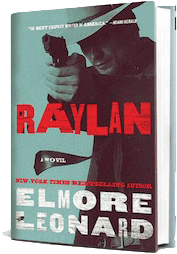
Since Sunday is my usual day for a book review, I decided I would link to one of the premier review places, The New York Times. Here is the opening of a recent review of Elmore Leonard's latest book, Raylan. The review was written by Olen Steinhauer.
 In an essay that appeared in The New York Times in 2001, “Easy on the Adverbs, Exclamation Points and Especially Hooptedoodle,” Elmore Leonard listed his 10 rules of writing. The final one — No. 11, actually — the “most important rule . . . that sums up the 10,” is “If it sounds like writing, I rewrite it.”
 It’s a terrific rule. In fact, I liked it so much that I passed it on to a creative-writing class I once taught. However, there’s more to Leonard's rule that I didn’t pass on: “Or, if proper usage gets in the way, it may have to go. I can’t allow what we learned in English composition to disrupt the sound and rhythm of the ­narrative.”

I thought this was a bit serendipitous, as Leonard is one of my favorite authors, and I love his rules of writing, especially his point about not letting proper usage disrupt the rhythm of the writing. The rhythm of our writing is what distinguishes our voice, and we need to let that have some freedom from the constraints of proper usage.

I hope you can go read the rest of the review of the new book in which U.S. Marshal Raylan Givens, now the star of the TV show “Justified,” returns to confront gambling, mining and organ trafficking in Elmore Leonard’s latest.

Monday, April 21, 2014

Say "no" to the TransCanada XL Pipeline

Those of you who have been following my blog for some time know that I am against the TransCanada XL Pipeline that is scheduled to open soon. Many of us in Texas fought to keep the pipeline from coming through, but alas, the pipes are already in, just waiting for the green light from Washington to open them up. A decision on the rest of the pipeline is expected soon, and I don't know if it is too late to stop it - just like it was too late to stop the pipe being laid here - but I hate the fact that Big Oil has the power to make this happen and is so indifferent to the danger the pipeline poses.


In Texas, where the pipeline would end, toxic pollution in the air and water is already dangerous. But introducing tar sands oil to an area already saturated with oil refineries and chemical plants would make a bad situation much, much worse.

Tar sands oil and Keystone XL would increase emissions of benzene, heavy metals, and other carcinogens into the air that residents near the pipeline breathe every day. Not to mention what will happen to the groundwater when there is a leak and all those toxins are released.


Something else I did not know is that the tar-sands mining in Canada also threatens habitats for wildlife, especially wolves in the Boreal Forest. In some areas where mining is already happening, wolves are being killed by people riding in helicopters and hunting the wolves down.


In my heart of hearts, I think President Obama doesn't want to approve the last leg of the pipeline that is supposed to go through the heartland of the U.S., but he is pressured by the power that Big Oil has in Washington. I pray that Obama can do the right thing.


I have also been a long-time fan of Kristen Lamb, a writer who lives in the Dallas area who shares advice and tips and inspiration for writers on Kristen Lamb's Blog. Here is just a bit from her latest offering about the rise and fall of social media and the influence of coffee. One of the things I like most about her blog posts is that they are written with a fine edge of humor, and I have such a good time reading them. Here is just a sampling from her latest offering:
Many of you are old enough to remember the dot.com boom (then bust) of the 1990s. The Internet was growing in popularity. More people were owning PCs and commerce was shifting on-line. The Old Guard yelled “WITCHCRAFT!”, threw holy water and shorted out their keyboards. The New Guard dived in with the enthusiasm of a kid at Chuck E. Cheese hopped up on sugar.
Creativity abounded. What products or services could be offered on-line? How could we improve the on-line experience? How could we make purchasing faster, safer, more appealing?
Early Adopters jumped all over this because that’s what Early Adopters do. Hey, someone had to be the first to eat an oyster, right?
How Coffee Transformed the Publishing Paradigm
Coffee not only fueled the Industrial Revolution, but apparently staying up all night unable to sleep led to the invention of the “computer,” “the Internet,” and later “iTunes.” The shift from “going to a physical store” commerce to more “e-commerce” set the stage for a number of unanticipated revolutions in the arts. If we think about it, when did the mega-bookstore enjoy its Golden Years?
Hint: Right about the time of the movie You’ve Got Mail, clearly marking the brief historical epoch when we actually enjoyed getting e-mails.
I think I'll grab a cup of coffee and go check my mail. Don't forget to grab a copy of Doubletake while it is still free. I am so thrilled that one reader has already taken the time to do a short review. She called the story "Spellbinding." This is the last day for the free offering to celebrate the book's release, so take advantage while you can.
Sunday, February 05, 2012

Book Reviews from the New York Times

I thought I would try something different this week. Thanks to a tip from Kristen Lamb, an awesome lady who gives advice to writers on her blog, I found out about a different approach to blog sharing. I have had writer friends, Slim Randles, Tracy Farr and Carl Brookins who have either sent me a review, as in the case of Carl, or given me permission to use one of their blog posts or essays. But what Kristen suggested recently is that we give a teaser on our blog with a link to the site where the original was posted.

Since Sunday is my usual day for a book review, I decided I would link to one of the premier review places, The New York Times. Here is the opening of a recent review of Elmore Leonard's latest book, Raylan. The review was written by Olen Steinhauer.

 In an essay that appeared in The New York Times in 2001, “Easy on the Adverbs, Exclamation Points and Especially Hooptedoodle,” Elmore Leonard listed his 10 rules of writing. The final one — No. 11, actually — the “most important rule . . . that sums up the 10,” is “If it sounds like writing, I rewrite it.” It’s a terrific rule. In fact, I liked it so much that I passed it on to a creative-writing class I once taught. However, there’s more to it, which I didn’t pass on: “Or, if proper usage gets in the way, it may have to go. I can’t allow what we learned in English composition to disrupt the sound and rhythm of the ­narrative.” 
 I thought this was a bit serendipitous, as Leonard is one of my favorite authors, and I love his rules of writing, especially:  “Or, if proper usage gets in the way, it may have to go. I can’t allow what we learned in English composition to disrupt the sound and rhythm of the ­narrative.”

I hope you can go read the rest of the review of the new book in which U.S. Marshal Raylan Givens, now the star of the TV show “Justified,” returns to confront gambling, mining and organ trafficking in Elmore Leonard’s latest.

Wednesday, May 18, 2011

Drama means conflict

 If you have not been a follower of Kristen Lamb's Blog, I highly suggest you check it out when you get a chance. She recently did a couple of posts dealing with conflict, and the one that really resonated with me was "Little Darlings and why they Must Die"  In that post she makes the point that complications do not equal conflict. She wrote:
The problem is, complexity is not conflict. We can create an interstellar conspiracy, birth an entirely new underground spy network, resurrect a dead sibling who in reality was sold off at birth, or even start the Second Civil War to cover up the space alien invasion…but it ain’t conflict. Interstellar war, guerilla attacks, or evil twins coming back to life can be the BACKDROP for conflict, but alone are not conflict.
 Before I read Kristen's post, I had just finished reading a book that had been sent to me for possible review. While the writing in the book was engaging in parts and the central character was interesting, I was lost in layers of complications and kept sensing that something was missing. That something was real conflict.

Then I thought about the trouble I had in finishing Stalking Season, the second book in my mystery series, and realized that I had been struggling with this issue of conflict vs. complications. With a mystery, we want lots of suspects and false trails, but I know I have to be careful that I don't focus too much on that and forget about the basics of conflict:

                                       Character > goal > impediments

Another way to look at this is to think of drama as action and reaction. A character sets out to accomplish a goal, other characters or circumstances keep him from the goal, and he reacts. Keep in mind that reaction is emotional as well as physical. For example  in a romance the couple might have a fight and one of them storms out. That is the physical reaction. The emotional is what the character feels and thinks about the fight and what it means to the relationship.

In my case, I had been concentrating on the procdural side of the detectives finding the killer, I had missed some opportunities for real conflict. I knew something was missing, just like I knew something was missing in the book I read for review, but I  couldn't define the missing part until that aha moment when I read Kristen's blog.

Writers, how do you handle conflict in your stories?