Showing posts with label The New York Times. Show all posts

Monday, April 14, 2014

Monday Morning Musings

A recent headline in the op/ed section of The Dallas Morning News caught my eye: Does porn harm kids? (By the way, I really don't like the new trend in headline writing that no longer capitalizes all the words. But maybe that's because I am now considered a dinosaur among journalists.)


Anyway, I found the article most interesting. In it David Segal, a business reporter for The New York Times, wrote about the results of scientific research that cannot difinitively prove there is a correlation between teen watching porn and then engaging in risky behavior, such as having unprotected sex or sex at a young age.

A report, produced by the Children's Commissioner in England studied 276 research papers on teens and pornography, showed that there could be a link between porn and risky behavior, but exactly what that link is could not be defined. Segal wrote, "Given the ease with which teenagers can find Internet pornography, it's no surprise that those engaging in risky behavior have viewed pornography online. Just about every teenager has. So blaming X-rated images for risky behavior may be like concluding that cars are a leading cause of arson because so many arsonists drive."

Luckily, Segal did not end the article there. I might have lost all my respect for him at that point. He included the results of a debate conducted by the Children's Commission that asked a group of teens, aged 16 to 18, to debate whether viewing porn had an impact on them. Half of the group, which was comprised of boys and girls, were to take the con arguments, the other the pro arguments. According to Miranda Horvarth, a professor of psychology at Middlesex University in London, the group arguing the pro side had very strong opinions. "They said it had an impact on their body image, on what young people thinks sex should be like, what they could expect from sex. They talked about how if you see things in pornography, you might think it's something you should be doing and go and do it."

The bottom line from researchers, and from David Segal, comes down to parental involvement and guidance. Parent-child conversations about sexuality separate from pornography is vital, as are controls of what very young children are exposed to. Rory Reid, a research psychologist and assistant professor at the University of California, Los Angeles offered this thought to Segal, "Putting a computer in a kids room without any limits on what can be viewed is a bit like tossing a teenager the keys to a car and saying: 'Go learn how to drive. Have fun.'"

What do you think? Do you think porn and violent video games have a negative impact on kids?

On a much brighter note, I do hope you will try to come back on Wednesday to meet my special guest that day; Harrison Cheung, who worked for Christian Bale as publicist, marketer, and personal assistant for almost a decade. His book, Christian Bale: The Inside Story of the Darkest Batman, has received high praise and offers a balanced and diplomatic look at the life of the most lauded Batman. I'll admit I am a fan and can't wait to read the book. 

Sunday, October 06, 2013

Book Review - Sort Of

Since I have no review ready and my friend Carl Brookins has not sent a review recently, I decided I would connect you to a few book review sites.

I have always enjoyed the reviews in newspapers and was even known to write a few for a couple of Dallas newspapers. Of course, that was back in the day when reviews were really reviews with a bit of critical analysis. Not what some people call a review on online book retail sites. I don't want someone to just tell me "This book was wonderful and you should read it." I want to know why he or she thought it was wonderful. What was compelling about the writing, the characters, and the plot?

Those were the questions that reviewers answered in the newspaper reviews. Unfortunately many of the newspapers have cut back on reviews, and even more unfortunately many of the newspapers have ceased publication. However, the The New York Times is still in business and every author I know would love to be reviewed there. A few have made it, but among my circle of close writing friends most of us are still waiting.

Trade magazines such as Publisher's Weekly and Library Journal  also evaluate the writing and are well-respected in the industry. The websites for both publications carry some of the same reviews that are in the magazines, so that is a good source for finding new books to read.

As an author, getting your book reviewed there carries some bragging rights, so let me take a moment to do some humble bragging - is that an oxymoron? I do believe it is. Anyway, I am thrilled that both publications have given the first two books in my Seasons Mystery Series, Open Season and Stalking Season,  strong reviews. I also want to brag on one of my sons who has written reviews for Library Journal. No, he did not review my books. He only reviews history books and biographies. Just want to make sure you know there was no nepotism involved. (smile)


 Another place that authors would love to be featured is National Public Radio (NPR). On air there are reviews, author interviews, and interesting commentaries about the latest fiction and nonfiction books. I always enjoy listening to the shows when I can tune in to them. (NPR reception is spotty out here in the boonies) But I recently discovered the online presence for them. There you can find lists of the best-selling books in hardback, paperback, and electronic, as well as the interviews and commentary.

Sunday, February 05, 2012

Book Reviews from the New York Times

I thought I would try something different this week. Thanks to a tip from Kristen Lamb, an awesome lady who gives advice to writers on her blog, I found out about a different approach to blog sharing. I have had writer friends, Slim Randles, Tracy Farr and Carl Brookins who have either sent me a review, as in the case of Carl, or given me permission to use one of their blog posts or essays. But what Kristen suggested recently is that we give a teaser on our blog with a link to the site where the original was posted.

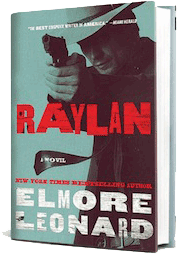
Since Sunday is my usual day for a book review, I decided I would link to one of the premier review places, The New York Times. Here is the opening of a recent review of Elmore Leonard's latest book, Raylan. The review was written by Olen Steinhauer.

 In an essay that appeared in The New York Times in 2001, “Easy on the Adverbs, Exclamation Points and Especially Hooptedoodle,” Elmore Leonard listed his 10 rules of writing. The final one — No. 11, actually — the “most important rule . . . that sums up the 10,” is “If it sounds like writing, I rewrite it.” It’s a terrific rule. In fact, I liked it so much that I passed it on to a creative-writing class I once taught. However, there’s more to it, which I didn’t pass on: “Or, if proper usage gets in the way, it may have to go. I can’t allow what we learned in English composition to disrupt the sound and rhythm of the ­narrative.” 
 I thought this was a bit serendipitous, as Leonard is one of my favorite authors, and I love his rules of writing, especially:  “Or, if proper usage gets in the way, it may have to go. I can’t allow what we learned in English composition to disrupt the sound and rhythm of the ­narrative.”

I hope you can go read the rest of the review of the new book in which U.S. Marshal Raylan Givens, now the star of the TV show “Justified,” returns to confront gambling, mining and organ trafficking in Elmore Leonard’s latest.

Monday, January 23, 2012

Monday Morning Musings

I read an interesting column by Nicholas Kristof in The New York Times about the worth of good teachers. His column was actually about great teachers and reported on a study that showed that "the difference between a strong teacher and a weak teacher lasts a lifetime."

He quoted some statistics that indicate a student is 1.25 percent more likely to go to college and 1.25 percent more likely not to get pregnant in high school if they have a great fourth grade teacher. While those are not huge numbers, they do represent individual students who did better because of the influence of one particular teacher. Those are students who have most likely grown up to be productive citizens and are not perpetuating an endless cycle of dropping out and either scrabbling for living or relying on government handouts for survival.

I remember that fourth grade was a pivotal year for most of my kids as they made their way through elementary school, and they did have a great teacher. She also happened to be a good friend and neighbor and to this day I thank her for being such a great influence on my kids, especially our oldest son.

David did not have a stellar academic career, in elementary school or high school, but it would have been much worse had he not had Ginger Liening as a teacher. He had a horrible time in third grade and was ready to run away from home and school both at the thought of another school year starting. Ginger, to her credit, didn't judge him on his past school experience or behavior. She encouraged him to start with a clean slate, so to speak, and I'm sure it was her mentoring that kept him from dropping out of school entirely.

So I agree with Kristof that school districts should find a way to keep those stellar teachers and weed out the weaker ones. Maybe then there would be a huge jump in the numbers of kids encouraged on to much better things.

On another note, I hope you will come back on Wednesday when Morgan Mandel is my guest. She is sharing some interesting facts about the Fountain of Youth, as well as a short excerpt from her latest book, Forever Young: Blessing or Curse


Fresh beginnings turn tragic when Dorrie Donato’s husband, Larry, is killed in a hit and run accident a few months after starting a new job at the Life is for Living Institute. Discouraged and desperate after  suffering countless setbacks, Dorie accepts an offer by  Larry’s boss, the famous Angel Man, to  be the first to test an experimental pill designed to spin its user back to a desired age and hold there, yet still retain all previous memories.  The pill seems too good to be true. Maybe it is.


Morgan Mandel is a former freelancer for the Daily Herald newspaper, prior president of Chicago-North RWA, prior Library Liaison for Midwest MWA, and belongs to Sisters in Crime and EPIC. She enjoys writing thrillers, mysteries, romances and also enjoys combining them. Her latest paranormal romantic thriller is Forever Young: Blessing or Curse, Book One of the Always Young Series, available on Kindle and Smashwords. Other novels by Morgan Mandel include the romantic suspense, Killer Career, the mystery, Two Wrongs, and the romantic comedy, Girl of My Dreams. Morgan is now working on Book Two of the Always Young Series, called Blessing or Curse: A Forever Young Anthology, where readers will learn what happens to others who have taken the Forever Young pill.  One more book will follow bringing back the original heroine to close out the series.