Showing posts with label health care. Show all posts

Friday, January 17, 2014

Friday's Odds and Ends

A recent story in the Dallas Morning News reported that the reservoirs serving the Dallas-area are 10% lower than a year ago and the continuing drought does not indicate that it's going to get any better. The area is more than 30 inches shy of normal rainfall over the last six years, yet nobody has taken really serious action toward a long-term solution to the water problem, other than looking at ways to bring in more water - pulling from East Texas reservoirs for one.


People still pour gallons and gallons of water on landscaping and lawns every year, in many cases trying to maintain greenery that was not meant to grow in this hot climate. Perhaps people should think more about whether their grandchildren or great-grandchildren might have a glass of water in their future instead of wanting the most luxurious green lawn today.

Jonathan Rauch, contributing editor to The Atlantic, wrote an interesting article about health care for the very elderly who too often end up in intensive care units at hospitals for the last weeks or days of their lives. He believes that is an unnecessary and extraordinary use of healthcare facilities and money. He wrote, "Hospitals are fine for people needing acute treatments, like heart surgery, but they are very often terrible place for the frail elderly."

The article was promoting the idea of home-based primary care, and to highlight the benefits of that approach, Rauch mentioned a program called Advanced Illness Management at Sutter Health, a giant network of hospitals and doctors in Northern California. Brad Stuart has worked there for the past 15 years, developing home-based care for frail, elderly patients, and he estimates that using that type of program and keeping patients out of the hospital saves Medicare upwards of $2000 a month on each patient, maybe more. "For years, many people in medicine have understood that late-life care for the chronically sick is not only expensive, but also, much too often, ineffective and inhumane."

Because Medicare is not set up to work with this type of program, that is one of the reasons that home-based medical care is not widely used across the country. The layers and layers of rules and requirements and policies for using Medicare seem to be cast in stone and don't leave room for a doctor or a patient or a hospital to figure out a more cost-effective way to handle a medical issue. For example,   there were people in the extended care unit of a hospital at which I worked who were receiving 6 to 8 weeks of IV antibiotics. I don't recall the exact cost of daily hospital stay, but it certainly was a lot more than had these people been allowed to go home with a visiting nurse coming in every day to administer the antibiotic, check the IV port to make sure it was working properly, and tend to any other medical needs the patient might have.

One time, two gentlemen who were stuck in this extended care unit decided that they would use that time to appeal to the government to rethink policy. They gathered statistics from the medical social worker on cost comparisons and then wrote letters to political leaders, starting at the state level and going all the way to Washington. The letters, with all the statistics and a recommendation to change the policy, were also sent to the people who manage and administrate Medicare. The responses that they receive back were often just a form letter that simply stated "We are sorry that our program does not allow for this type of in-home healthcare that you are requesting."

Nobody seemed to be able to look at this idea and say, "Hmmm, maybe we should figure out a way to implement this cost-saving measure and save the taxpayers a whole lot of money."

I know, I know. Government bureaucrats don't seem to understand simple and efficient. And from all outward appearances, they don't seem eager to figure it out.

Isn't this a better setting than a hospital? Photo courtesy of My Elder Advocate
It's been a while since I've done Literary Lessons, and this is a good one from Tennessee Williams' classic play "Cat on a Hot Tin Roof." The line belongs to Big Daddy, "Ignorance of mortality is a comfort. Men don't have that comfort, he's the only living thing that conceives of death, that knows what it is, the others go without knowing. A pig squeals, but a man, sometimes you can keep a tight mouth about it."

That's kind of depressing, so let's end on a joke.

"How is it that we put man on the moon before we figured out it would be a good idea to put wheels on luggage?"

Friday, March 26, 2010

Now for a little levity...

I figured since I did a couple of days of ranting, it was time for a break. My friend, Tracy Farr, did a hilarious post on his blog today. He wrote a letter to President Obama about Health Care. Here is just a teaser, and I hope you will go over to Tracy's blog and read the whole piece.

Dear Mr. President,

Thank you so much for being president. I thought for awhile that I might have to do the job, but since nobody would ever vote for a person who promises "jobs for everyone, better education, and a few goats in the backyard," it's probably best that you took it and not me.

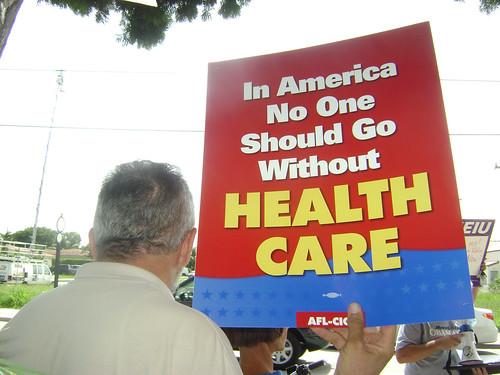
Health Care Rally for a Public Option in front of  Senator Bill Nelson´s Office
I know that you get many, many letters a day from people telling you what to do, telling you how good or bad you are, wanting you to sign up for new satellite TV service at great introductory low prices -- but that's not why I'm writing. I would like to talk to you today about Health Care.

Now, I'll be the first one to tell you that I don't know diddly about Health Care. For that matter, I don't know much about history, don't know much biology, don't know much about a science book, don't know much about the French I took. (Hmmmm...sounds like that could be some cool song lyrics. I'll work on that later.)...........

Find the rest HERE


Friday, November 06, 2009

Read My Lips

It's Not a Death Squad

Thousands of people are protesting the health care plan being considered in Washington for all the wrong reasons. They are zeroing in on the section on end-of-life issues and promoting the idea that the provision means the government will be telling people when to die.

Sarah Palin is one of the most out-spoken, and perhaps influential, people stirring up this frenzy. In her blog and elsewhere she uses rhetoric that doesn't enlighten. It just stirs up emotion. This is from a commentary about her blog:

Palin was quick to note that the health care plan could make decisions regarding anyone at the end of their life, which might include her baby. She believes her parents and baby will have to leave it in the hands of Obama’s “death panel” to determine whether they are worthy of receiving health care. This is certainly not something anyone would want to face or see their loved ones experience.

The truth about that provision is that the government would provide funds to educate people about the importance of making end-of-life decisions and using Advance Directives and Medical Power of Attorney documents to make their wishes known. This isn't something we are comfortable talking about, but tough questions need to be asked and answered.

If you have cancer and are 80 years old and have a heart attack, do you want full resuscitation. Do you want to be on a ventilator in ICU?

If you have been in an accident and are brain dead, do you want to be kept on machines for an indefinite period of time?

If you have a terminal illness and can no longer eat, do you want tube feedings?

I worked for eight years as hospital chaplain and dealt with many situations where these questions had to be answered during times of extreme emotional distress. Family members were looking at their loved ones and feeling a desperate need to keep them alive. Because their emotions were so raw, they couldn't see past that to the pain and misery their husband, wife, mother, father, sister or brother might have been going through.

Being in ICU on a ventilator is not a pleasant experience.

And it is an extremely expensive proposition.

In our medical ethics sessions we would often discuss the sad fact that thousands of dollars were spent daily to keep a body alive when a person should have died days or weeks earlier without the pain and desperation that is so often the case in an ICU.

Which doesn't mean that every case in ICU or Oncology is hopeless. But many an ICU nurse would share their frustration with me over the fact that they had to keep sedating some poor old lady who kept trying to pull all the tubes out and that poor old lady died a week later anyway. She just had seven days of misery. And took seven days of time and attention that needed to go to a patient who had a chance for a positive outcome.

As part of my job, I had to start talking to patients about Advance Directives. It was easier to talk to them and to families when they were not in a crisis situation. It was also easier on them to have someone trained to deal with death and dying issues and with what the documents provide. Which is the point, I think, of this provision in the health care plan.

I know. I wish I had someone to help me talk to my mother about this.

So, if you want to protest the health care plan, protest because it is going to cost too much. Or protest because it is going to be administered by the government, who are so efficient with administrative matters. But don't protest the end-of-life provision.

We all need to think about how we are going to go "into that goodnight."

Tuesday, September 02, 2008

Health Care Fiasco

A growing health problem in the United States is people who cannot get medical care because they don't have a primary doctor for referrals. An article in the September AARP Bulletin addresses the shortage of primary care doctors and it doesn't bode well for the future.

It doesn't bode well for the present, either.

More and more people are finding that they may end up with a deadly condition because they could not get in to see a doctor in a timely manner. That happened to a woman in Sacramento who had a mole on her arm that was changing. She tried to see a dermatologist without the referral from a primary care doctor, but the ones she called said they couldn't see her for three to four months. This despite the fact that she had an issue of considerable concern.

When she finally got to see a doctor seven months after discovering the mole, she was diagnosed with melanoma, which has now spread to her lungs.

And I thought it was terrible that I couldn't get in to see a new primary care doctor for a month.

I wish the story of the woman in Sacramento was an isolated case, but unfortunately it is not. And I don't even know what would be a good first step toward solving this problem. I just hope that it has come to the attention of someone with a better mind than mine.